


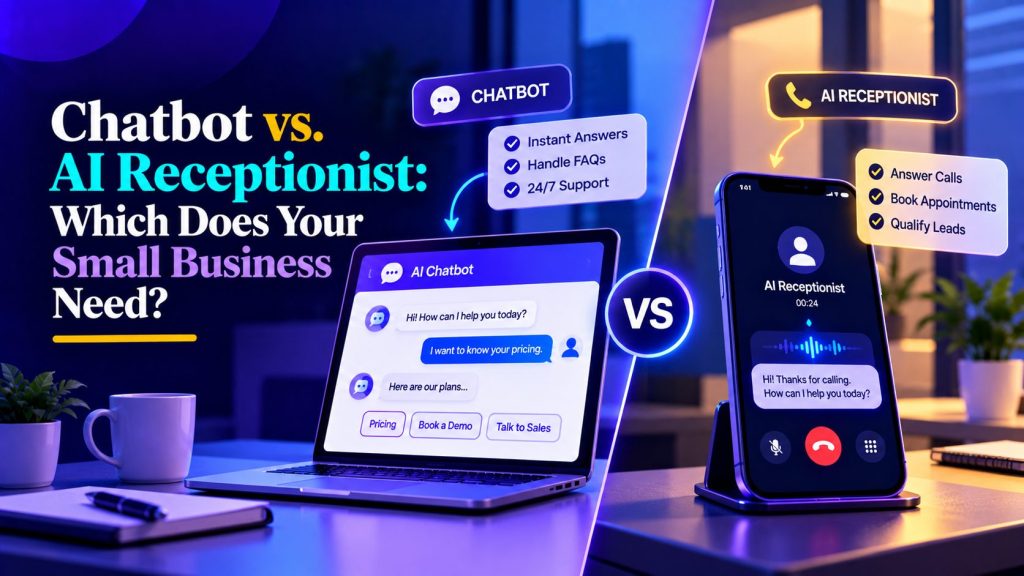
Running a small business means juggling customer inquiries, appointments, and daily operations, often with limited staff. When calls go unanswered or website visitors leave without getting help, valuable opportunities slip away.
Choosing between a chatbot vs AI receptionist can help solve these challenges, but each serves a different purpose. Understanding how they work, what they cost, and where they add value makes the decision easier. This guide explores their differences, practical applications, and how to choose the right solution for your business.
What Is an AI Chatbot, and How Does It Help Small Businesses?
An AI chatbot is a digital assistant that communicates with customers through text. It answers questions, guides website visitors, and helps businesses manage online inquiries without requiring employees to respond manually.
A website chatbot is a familiar example. Customers can use the chat window to ask questions such as “What are your business hours?” or “Do you offer weekend appointments?” The chatbot responds using information provided by the business.
Unlike traditional rule-based chatbots, conversational AI systems can interpret different ways of asking the same question.
Common chatbot applications include:
- Answering frequently asked questions
- Providing product and service information
- Collecting contact details through lead capture automation
- Directing visitors to relevant website pages
- Helping customers check appointment availability
For example, a landscaping company might use a chatbot to answer questions about lawn maintenance packages while its employees work on customer properties.
However, a website chatbot generally cannot answer traditional phone calls unless it connects to a separate voice system.
What Is an AI Receptionist, and How Does It Work?
An AI receptionist uses voice AI agents to answer business phone calls, communicate with callers, and handle routine reception tasks through spoken conversations.
If you’re wondering what an AI receptionist is, imagine a caller contacting a dental office to ask about appointment availability. Instead of reaching voicemail, the caller speaks with an AI voice receptionist that understands the request and responds naturally.
Depending on its capabilities and integrations, the system can:
- Answer incoming business calls
- Collect caller names and contact information
- Provide answers to routine questions
- Support appointment scheduling automation
- Transfer calls to the appropriate employee
- Record messages and provide call summaries
An AI answering service can also support after-hours call answering, allowing customers to reach a business outside regular working hours.
For small teams, this reduces interruptions without requiring customers to navigate complicated phone menus.
Businesses considering an AI receptionist for small business should evaluate whether the service supports customized call routing, accurate message collection, and transfers to human receptionists when necessary.
Portable AI Agents In Seconds, Use Everywhere
Prompt, Test, and Deploy AI Agents Across Social Platforms and LLMs. Automate Everything.
What Is the Difference Between a Chatbot and an AI Receptionist?
The main difference between chatbot and AI receptionist is how customers communicate with them. Chatbots primarily handle written conversations, while AI receptionists manage spoken phone interactions.
Both can answer questions and collect customer information, but they support different stages of the customer journey.
| Feature | AI Chatbot | AI Receptionist |
| Communication | Text-based | Voice-based |
| Primary channel | Website or messaging apps | Business phone line |
| Customer interaction | Typing messages | Speaking naturally |
| Common tasks | FAQs, website guidance, lead forms | Call answering, intake, call transfers |
| Availability | Often 24/7 | Often 24/7 |
| Appointment booking | With scheduling integration | With scheduling integration |
| Human handoff | Live chat or support ticket | Live call transfer |
| Best suited for | Website inquiries | Phone inquiries |
When comparing AI receptionist vs chatbot solutions, businesses should focus on how customers prefer to contact them rather than assuming one technology offers more value.
A customer researching products may prefer written answers. Someone facing an urgent plumbing problem may want to speak to someone immediately.
That distinction matters more than the technology itself.
Which Solution Works Better for Different Small Business Needs?
The right solution depends on customer behavior, inquiry volume, and the tasks your employees handle throughout the day.
When Should a Small Business Choose a Chatbot?
A chatbot works well when customers primarily discover services through a website and need quick answers before making a decision. For service businesses, AI appointment booking can also help turn those conversations into scheduled meetings without repeated back-and-forth.
Consider an online clothing store. Visitors may ask about shipping policies, return windows, or available sizes. A chatbot can answer these questions while customers browse.
Chatbots are particularly useful for businesses that receive substantial website traffic but relatively few phone calls.
They also support website visitor engagement by helping potential customers find information without searching through multiple pages.
However, businesses should monitor chatbot responses to prevent inaccurate product information or confusing recommendations.
When Should a Small Business Choose an AI Receptionist?
An AI receptionist works well when incoming phone calls drive appointments, consultations, service requests, or sales opportunities.
For example, a home repair company may receive calls while technicians work at customer locations. Without someone available to answer, potential customers might contact another provider.
Using AI call handling for small business operations helps capture these inquiries and organize follow-up information.
The importance of timely responses extends beyond phone calls. A Harvard Business Review lead-response study found that companies contacting online leads within an hour were nearly seven times as likely to qualify them as companies waiting another hour.
Although the research dates to 2011 and examined online leads rather than AI receptionists, it demonstrates why businesses should take response delays seriously.
Can Businesses Use Both Without Complicating Customer Service?
Yes. Businesses can use a chatbot for online inquiries and an AI receptionist for phone conversations while keeping customer information organized.
For instance, a medical practice might use website chat to explain office hours and general services, while its phone receptionist handles appointment requests and routes urgent administrative matters.
The key is to establish consistent answers, clear responsibilities, and reliable handoffs.
Without coordination, customers may receive conflicting information or repeat their details across channels.
How Do AI Receptionists Compare With Live Receptionists and Traditional Answering Services?
The virtual receptionist vs chatbot comparison becomes more meaningful when businesses consider human involvement.
A live virtual receptionist answers calls remotely, while an AI receptionist uses software to manage conversations.
In a chatbot vs live receptionist comparison, the human receptionist generally offers stronger judgment when handling unusual requests, frustrated customers, or sensitive discussions.
Similarly, an AI receptionist vs answering service comparison depends on the service model. Traditional answering services often use human operators, while AI systems automate routine conversations. Some providers combine both approaches.
Businesses evaluating the best virtual receptionist for small business should consider whether callers can reach a real person when automated assistance becomes insufficient.
This matters particularly for legal offices, healthcare practices, and professional services, where customers may need reassurance or individualized attention.
How Can Small Businesses Decide Which Technology Is Worth the Investment?
Start by examining where customer inquiries originate, which interactions employees struggle to manage, and how much time those tasks consume.
A practical decision process includes:
- Review communication channels: Compare monthly phone calls, website chats, and contact form submissions.
- Identify missed opportunities: Look for unanswered calls, abandoned conversations, and delayed follow-ups.
- Calculate operating costs: Consider subscriptions, usage charges, setup fees, and employee time.
- Check integrations: Confirm compatibility with calendars, customer databases, and existing phone systems.
- Test real conversations: Evaluate response accuracy, customer experience, and escalation procedures.
The need for responsiveness is supported by customer research. In its State of the Connected Customer report, Salesforce found that 80% of business buyers said an immediate response when seeking support influenced their loyalty.
The finding comes from a 2016 survey, but it reinforces the importance of making customer communication convenient.
For 24/7 call answering for small businesses, compare how effectively each provider handles overnight inquiries, transfers, and follow-up messages rather than focusing only on advertised availability.
What Should Businesses Check Before Introducing AI Customer Support?
Businesses should prioritize accuracy, customer privacy, and the ability to reach a human when necessary. Fast responses mean little if customers receive incorrect information.
Before introducing AI phone answering vs website chat solutions, test both against real customer situations.
Consider these questions:
- Does the system explain when customers are interacting with AI?
- Can employees correct outdated answers?
- Does it protect sensitive customer information?
- Can it recognize requests requiring human judgment?
- Can managers review conversations and identify recurring problems?
For example, an automated assistant should not independently promise emergency service availability or provide personalized medical advice.
Businesses should also establish clear human escalation protocols and review applicable privacy, recording, and industry regulations.
These safeguards help make automation useful without sacrificing customer trust.
Which Customer Communication Solution Should You Choose?
The right technology should make your business easier to reach, not harder to understand. Chatbots help customers find answers online, while AI receptionists keep phone conversations moving when your team cannot answer. Neither replaces the importance of thoughtful, personal service. Start by identifying where inquiries go unanswered and what customers expect from your business. Then partner with a trusted communication service provider that offers reliable technology, transparent pricing, and human support when needed.
Make every customer conversation count by choosing the right support solution today.
Frequently Asked Questions
1. Is an AI receptionist better than a chatbot?
Neither is universally better. AI receptionists suit phone-heavy businesses, while chatbots support online visitors. Compare customer preferences, inquiry volume, and operational needs before choosing either solution.
2. Can a chatbot answer phone calls?
A standard text chatbot cannot answer telephone calls independently. However, some platforms combine chatbot technology with voice recognition and telephony integrations to support spoken customer conversations.
3. Can an AI receptionist replace a human receptionist?
An AI receptionist can manage repetitive tasks, but human employees remain valuable for sensitive situations, unusual requests, complex decisions, and conversations requiring empathy or professional judgment.
4. Which is better for a small business, a chatbot or an AI receptionist?
The better choice depends on where customers contact you most frequently. Businesses receiving more calls may prioritize voice assistance, while website-focused businesses may benefit from chat.
5. Do I need a chatbot or an AI receptionist if my business receives few inquiries?
Not necessarily. If employees manage inquiries comfortably, existing tools may be sufficient. Start tracking missed contacts and response delays before investing in additional customer communication technology.
AI Agentic Platform For Building Portable AI Agents
Say Hello To Agentic AI That Connects With Your CRM And Even Other Agents