


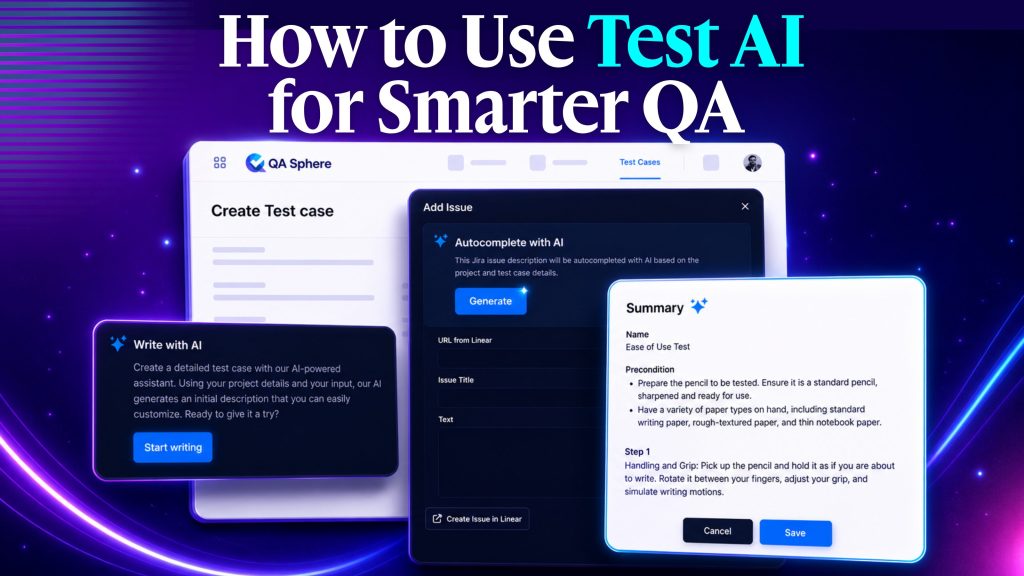
The transformation of quality assurance from manual drudgery characterized by tedious test case authoring, repetitive execution tracking, and reactive defect discovery to AI-powered intelligence that automates documentation, orchestrates execution intelligently, and predicts problems before they manifest represents one of the most significant advances in software development practices over the past decade. Traditional QA workflows consumed enormous time on administrative overhead including manually writing test cases from requirements, tracking execution status through spreadsheets, triaging test failures to determine whether they represent real bugs or environmental issues, and constantly maintaining brittle test automation that broke with every code change. These manual processes limited how much testing teams could realistically accomplish, creating inevitable tradeoffs between coverage breadth and release velocity where comprehensive validation meant delayed releases while rapid shipping meant inadequate testing that allowed defects to reach production.
This overview of practical strategies for leveraging AI in everyday QA workflows demonstrates that test AI isn’t futuristic technology requiring specialized expertise but accessible capabilities that any testing team can implement immediately to achieve dramatic efficiency improvements and quality gains.
Understanding Test AI Capabilities
AI test case generation converting diverse inputs into structured tests
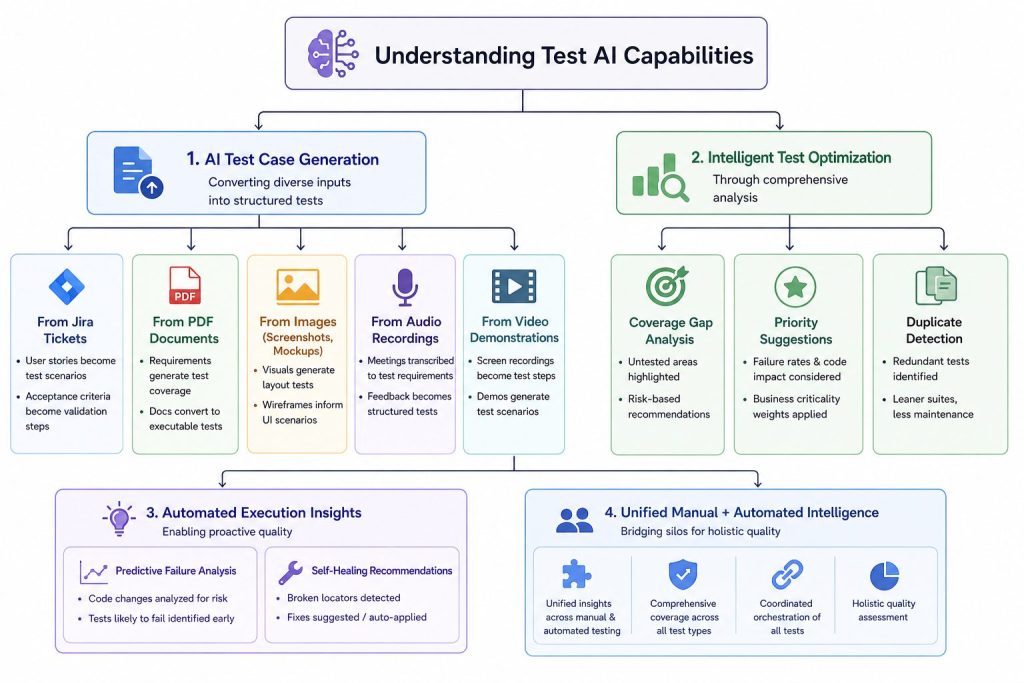

Test AI accepts requirements in virtually any format and automatically generates comprehensive, well-structured test cases eliminating the manual authoring that traditionally consumed the majority of test documentation effort, similar to how an AI agent can automate complex workflows across systems:
From Jira tickets:
- User stories automatically become test scenarios with appropriate coverage
- Acceptance criteria transform into detailed validation steps
- Story descriptions inform preconditions and setup requirements
- Links maintain traceability from requirements to tests automatically
From PDF documents:
- Requirements specifications generate corresponding test coverage
- Technical documentation becomes executable test procedures
- Design documents inform validation approaches and scenarios
- Legacy documentation imports and converts to modern formats seamlessly
From images including screenshots and mockups:
- Visual designs generate layout validation test cases
- Wireframes inform UI testing scenarios systematically
- Diagrams document workflow testing requirements
- Interface specifications become structured validation tests
From audio recordings:
- Stakeholder meetings transcribe and convert to test requirements
- Verbal feedback becomes actionable structured test cases
- Interview notes transform into comprehensive test documentation
- Voice memos generate test cases preserving stakeholder intent
From video demonstrations:
- Screen recordings become detailed step-by-step test procedures
- Demo sessions generate test scenarios covering demonstrated workflows
- Tutorial videos inform test case creation comprehensively
- User interactions document expected application behaviors precisely
Intelligent test optimization through comprehensive analysis
Test AI analyzes existing test suites systematically to identify improvement opportunities:
Coverage gap analysis:
- Untested functionality highlighted automatically
- Requirements lacking test coverage identified
- Feature areas receiving insufficient validation flagged
- Risk-based recommendations for additional testing
Priority suggestions:
- Historical failure rates inform test prioritization
- Code change impact analysis guides execution order
- Business criticality weights test importance
- Resource constraints considered in recommendations
Duplicate detection:
- Redundant test cases covering identical scenarios identified
- Similar tests consolidated to reduce execution overhead
- Maintenance burden decreased through deduplication
- Leaner test suites executing more efficiently
Automated execution insights enabling proactive quality
Test AI provides intelligence during and after test execution:
Predictive failure analysis:
- Code changes analyzed for regression risk
- Tests most likely to fail identified before execution
- Intelligent prioritization focuses effort on high-risk areas
- Proactive defect prevention through targeted testing
Self-healing recommendations:
- Broken locators identified and alternatives suggested
- Automated fixes applied when confidence high
- Maintenance effort reduced dramatically
- Test stability improved continuously
Unified manual plus automated intelligence
AI for software testing bridges the traditional silos separating manual and automated testing by providing unified insights across both execution types, comprehensive coverage analysis combining all test methods, coordinated orchestration treating manual and automated tests as complementary rather than separate, and holistic quality assessment based on complete testing picture rather than fragmented views.
AI-Powered Test Case Creation
Practical steps for leveraging AI generation:
Step 1: Paste Jira ticket and AI generates comprehensive scenarios
- Copy story or requirement description
- Paste into test AI generation interface
- AI analyzes content and extracts key behaviors
- System generates multiple test scenarios automatically covering happy paths, edge cases, and error conditions
- Review and refine generated test cases as needed
- Link tests back to originating tickets for traceability
This approach is similar to how teams use an AI agent builder to automate complex workflows and continuously improve system outputs.
Step 2: Upload Figma screenshot and AI extracts UI tests
- Export designs or mockups as images
- Upload to test AI platform
- AI analyzes visual layout and components
- System generates UI validation test cases checking element positioning, styling consistency, responsive behavior across screen sizes, and visual hierarchy
- Tests become executable specifications
Step 3: Convert meeting audio into structured acceptance criteria
- Record stakeholder discussions about features
- Upload audio files to AI processing
- System transcribes and analyzes conversations
- AI extracts requirements and generates acceptance criteria
- Test cases created automatically from discussions
- Knowledge captured that would otherwise be lost
Step 4: Import spreadsheet requirements for comprehensive coverage
- Export requirements from existing documentation
- Import spreadsheets into test AI system
- AI processes rows as individual test scenarios
- Bulk test case generation creates entire suites
- Legacy documentation migrates to modern formats
- Comprehensive coverage achieved rapidly
TestMu AI (Formerly LambdaTest) advantage through multi-format processing
TestMu AI’s test AI reduces creation time substantially by accepting any input format, understanding context regardless of source, generating consistent well-structured test cases, and enabling teams to create and work with synthetic test data for comprehensive testing without relying on sensitive production data.
Smart Test Planning and Prioritization
AI analyzes multiple factors for optimal test planning:
Requirements complexity assessment:
- Complex features receive more thorough testing
- Simple changes get appropriate lightweight validation
- Testing effort matches actual risk appropriately
Historical failure rate consideration:
- Areas with frequent defects prioritized higher
- Stable functionality tested less intensively
- Resources focus where problems occur
Business impact weighting:
- Critical user workflows receive priority
- Revenue-generating features tested thoroughly
- Nice-to-have functionality validated appropriately
Generates optimal test plans balancing coverage versus execution time:
- Comprehensive validation within time constraints
- Intelligent tradeoffs when full coverage impossible
- Maximum quality assurance from available resources
- Efficiency optimized through AI analysis
Dynamic reprioritization based on code changes:
- New commits analyzed for impacted areas
- Test priorities adjust automatically
- High-risk changes trigger additional testing
- Regression focus adapts to actual modifications
Pro tip: Leverage AI-driven coverage gap identification
TestMu AI’s coverage analysis reveals untested functionality automatically, highlights requirements lacking validation, identifies feature areas with insufficient testing, and provides actionable recommendations for closing gaps rather than requiring manual analysis of thousands of test cases trying to spot what’s missing.
Guided Exploratory Testing
AI-enhanced manual testing providing structure:
Structured step capture with auto-suggestions:
- Test AI observes tester actions during exploration
- Suggests next steps based on current context
- Documents exploration systematically automatically
- Reproduces manual testing sessions easily
Real-time evidence logging:
- Screenshots captured automatically at key moments
- Videos record complex interaction sequences
- Logs associate with specific test activities
- Complete evidence documentation without manual effort
Failure pattern recognition during execution:
- Test AI identifies similar issues from past defects
- Suggests likely root causes based on symptoms
- Links to related historical failures
- Accelerates debugging through pattern matching
Remarks auto-linked to similar past defects:
- Tester observations analyzed automatically
- Connections to previous similar issues identified
- Historical context provided immediately
- Knowledge accumulated and leveraged continuously
Automated Test Intelligence
Self-healing locators reducing maintenance dramatically
Traditional test automation breaks constantly when developers refactor code changing element identifiers. Test AI implements self-healing that is increasingly powered by agentic AI systems capable of adapting and making decisions autonomously:
- Identifies elements through multiple characteristics simultaneously
- Automatically adapts when primary locators fail
- Suggests alternative locators before tests break
- Reduces maintenance effort substantially
- Improves test stability continuously
Organizations report maintenance time dropping when test AI handles locator adaptation automatically rather than requiring manual script updates every time interfaces change.
Predictive flakiness detection before execution
Flaky tests that pass and fail intermittently without code changes waste enormous time investigating false alarms. Test AI predicts flakiness by:
- Analyzing historical test result patterns
- Identifying tests with inconsistent outcomes
- Flagging likely flaky tests before execution
- Recommending fixes for common flakiness causes
- Improving overall test suite reliability
Intelligent parallelization optimizing resource usage
Test AI for software testing distributes test execution intelligently by:
- Analyzing test dependencies and execution times
- Grouping tests optimally for parallel execution
- Balancing load across available infrastructure
- Minimizing total execution time
- Maximizing resource utilization efficiency
TestMu AI HyperExecute plus AI for accelerated cycles
Combining HyperExecute’s massive parallelization capabilities with AI-driven intelligent orchestration completes comprehensive test suites in minutes rather than hours, enabling continuous testing practices where validation happens on every code commit without creating pipeline bottlenecks.
Unified Manual Plus Automated AI Insights
TestMu AI Test Manager workflow integrating AI throughout:
Manual testing with AI guidance:
- AI guides execution through test steps with contextual suggestions
- Smart evidence capture happens automatically during testing
- System documents observations and findings systematically
- Results feed into unified quality assessment
Automated testing with AI orchestration:
- AI orchestrates test runs based on code change analysis
- Intelligent result analysis distinguishes real failures from environmental issues
- Self-healing applies automatically when appropriate
- Execution optimizes continuously through learning
Unified dashboard providing actionable insights:
- Single view combines manual and automated testing
- AI highlights critical issues requiring immediate attention
- Coverage analysis shows complete validation picture
- Quality trends become immediately apparent
- Actionable recommendations guide next steps
Advanced AI Analytics
Key AI-powered metrics for comprehensive quality assessment:
Test coverage optimization score:
- Quantifies how efficiently test suite covers functionality
- Identifies redundant testing wasting resources
- Highlights under-tested areas needing attention
- Tracks coverage improvement over time
Defect escape prediction probability:
- Estimates likelihood of bugs reaching production
- Based on coverage analysis and historical patterns
- Enables risk-based release decisions
- Guides additional testing when probability high
Resource allocation recommendations:
- Suggests optimal distribution of testing effort
- Balances manual versus automated testing
- Guides team assignments based on skills and workload
- Maximizes quality outcomes from available capacity
Velocity trend forecasting:
- Predicts testing throughput based on historical data
- Enables realistic schedule planning
- Identifies bottlenecks before they impact deadlines
- Supports capacity planning decisions
ROI per test suite analysis:
- Quantifies value delivered by different test groups
- Identifies high-value tests worth maintaining
- Flags low-value tests candidates for removal
- Optimizes testing investment continuously
Team-Specific AI Strategies
QA Engineers
AI test step suggestions during manual execution:
- Context-aware recommendations while testing
- Common next steps suggested automatically
- Edge cases prompted proactively
- Comprehensive coverage achieved naturally
Smart failure reproduction with contextual evidence:
- AI captures complete reproduction steps automatically
- Evidence collected during failure discovery
- Developers receive everything needed for debugging
- Back-and-forth communication eliminated
Personalized test recommendation engine:
- AI learns individual tester strengths and preferences
- Test assignments optimized for skills
- Training recommendations based on gaps
- Career development supported through insights
Test Architects
AI coverage optimization across test pyramids:
- Unit, integration, and UI test balance analyzed
- Recommendations for optimal distribution
- Redundancy identified across layers
- Efficient pyramid structure achieved
Risk-based test suite evolution recommendations:
- Historical defect patterns inform priorities
- High-risk areas receive appropriate coverage
- Low-risk stable code tested efficiently
- Suite adapts as application evolves
Cross-project pattern analysis:
- AI identifies common issues across projects
- Best practices propagated automatically
- Organizational learning accelerated
- Quality improvements shared systematically
Developers
AI-generated unit and integration tests from code changes:
- Commits analyzed for test generation opportunities
- Tests created automatically for new functionality
- Coverage expanded without manual effort
- Quality integrated into development naturally
Self-service AI test validation in pull requests:
- Developers trigger tests independently
- AI analyzes results and provides clear feedback
- Dependency on QA team reduced
- Development velocity increased
Intelligent bug reproduction workflows:
- Production issues analyzed automatically
- Reproduction steps generated from logs and evidence
- Local debugging enabled quickly
- Resolution accelerated significantly
Best Practices and Pitfalls
Start with high-impact workflows:
- Focus initial test AI adoption on critical paths
- Prove value quickly on important scenarios
- Build confidence before broader rollout
- Learn on manageable scope
Validate AI suggestions with human oversight:
- Review generated test cases before execution
- Verify coverage recommendations make sense
- Ensure business context considered appropriately
- Maintain human-in-loop for quality
Continuously train on team data:
- Feedback improves AI accuracy over time
- Domain-specific learning enhances relevance
- Team conventions incorporated automatically
- Continuous improvement through usage
Combine AI with human exploratory testing:
- AI handles repetitive validation efficiently
- Humans investigate novel scenarios creatively
- Complementary strengths maximize quality
- Balanced approach delivers best results
Don’t treat AI as set and forget:
- Ongoing oversight maintains quality
- Regular review ensures continued relevance
- Adaptation as applications evolve
- Active management of AI capabilities
Don’t ignore business context in AI prioritization:
- AI needs input on business criticality
- Technical factors alone insufficient
- Strategic priorities guide testing focus
- Human judgment remains essential
Don’t skip AI model retraining:
- Initial models improve with feedback
- Application changes require adaptation
- Domain evolution necessitates updates
- Continuous learning maintains effectiveness
Future of Test AI
Autonomous test agents managing entire QA cycles:
- Self-managing test suites requiring minimal human oversight
- Automatic priority adjustment based on changes
- Intelligent resource allocation without configuration
- End-to-end quality assurance automation
Predictive synthetic testing from user behavior data:
- Production usage patterns inform test generation
- Real user workflows tested automatically
- Synthetic tests match actual behavior
- Proactive quality assurance before users affected
AI-generated test data matching production patterns:
- Realistic data sets created automatically
- Privacy-preserving synthetic data generation
- Edge cases covered comprehensively
- Data management burden eliminated
Cross-team AI collaboration agents:
- AI coordinates testing across multiple teams
- Dependencies managed automatically
- Knowledge shared systematically
- Organizational quality elevated
Conclusion
TestMu AI test AI transforms quality assurance from reactive firefighting where teams constantly chase defects that escaped inadequate testing into proactive intelligence where comprehensive validation happens efficiently, problems get predicted before they manifest, and quality becomes built-in rather than bolted-on through last-minute testing phases that inevitably miss issues due to time constraints. The capabilities explored including AI-powered test case generation from any input format, intelligent test optimization identifying coverage gaps and redundancy, automated execution insights with self-healing and predictive analysis, unified manual and automated intelligence, and advanced analytics providing actionable recommendations represent fundamental advances in how testing operates rather than incremental improvements to existing processes.
Strategic AI adoption delivers efficiency gains immediately rather than requiring lengthy implementations before value realization because test AI integrates naturally into existing workflows through Jira synchronization, CI/CD pipeline connections, and familiar interfaces that reduce learning curves. Organizations report that starting small with focused use cases on critical workflows proves value quickly, building confidence and internal champions who drive broader adoption across teams and projects. The transformation doesn’t require replacing existing tools or processes wholesale but rather augmenting current approaches with intelligence that eliminates manual overhead, scales validation beyond human limitations, and provides insights impossible without AI analysis of comprehensive testing data.
Start small with manageable scope proving value on important workflows, scale smart by expanding systematically based on lessons learned and demonstrated ROI, and recognize that AI for software testing represents your QA superpower enabling testing teams to achieve quality outcomes and velocity previously impossible regardless of team size or resource constraints. Test AI isn’t futuristic technology requiring specialized expertise but accessible capabilities available today through platforms like TestMu AI that democratize artificial intelligence for software testing, making advanced capabilities practical for any organization committed to delivering high-quality software efficiently in competitive markets where quality and speed both determine success.
AI Agentic Platform For Building Portable AI Agents
Say Hello To Agentic AI That Connects With Your CRM And Even Other Agents