


ChatGPT consulting companies assist companies in figuring out the right areas for using ChatGPT technology and its deployment that won’t bring any additional risks.
Some consulting companies specialize more in providing strategic advice. They will help you figure out use cases, calculate potential ROI, compare technologies, and create an adoption plan. It may come in handy when a business plans to start using AI but hasn’t decided which workflow should be automated first.
Other consulting firms do the implementation and deliver a working product. They can make prototypes, integrate OpenAI APIs, develop a custom chatbot, use RAG, integrate ChatGPT with CRM or helpdesk solutions, test a workflow, and continue assisting after integration.
It’s a huge difference. While one will provide only a roadmap, another one can actually implement it by building software you need.
What Can a ChatGPT Consultant Do for Your Business?
ChatGPT consultancy will be useful in automating customer support, developing knowledge bases, creating marketing copy, analyzing data, integrating APIs, and working with agentic AI .
In the field of customer support, ChatGPT will be able to respond to frequent questions, organize tickets, compose replies, and provide assistance to agents in finding appropriate information. In addition, it can significantly decrease the amount of duplicate requests received by your team each day.
As a knowledge assistant for your team, ChatGPT will save you from going through files, policies, manuals, and past documentation and asking your question to receive a reply.
Marketing teams may use it for first drafts, campaign ideas, content repurposing, and variations of product copy. Analytics and operations teams can use it to summarize reports, process documents, or pull key points from messy data.
The more serious projects usually involve integrations. A consultant can connect ChatGPT with CRMs, ERPs, helpdesk tools, document storage, analytics platforms, or custom internal software.
In advanced cases, companies build AI agents . These systems do not only answer questions. They can follow steps, call tools, update systems, and help employees complete multi-step tasks with human approval where needed.
Portable AI Agents In Seconds, Use Everywhere
Prompt, Test, and Deploy AI Agents Across Social Platforms and LLMs. Automate Everything.
How to Choose a ChatGPT Consulting Company: 6-Step Framework
Step 1 – Define Your Workflow Goals
Start with the problem, not the model.
Before you talk to vendors, write down what is actually slowing your team down. Maybe support agents answer the same questions all day. Maybe employees cannot find information in internal documents. Maybe sales managers spend too much time writing follow-ups. Maybe reports are still prepared by hand.
After that, decide what kind of help you need. Do you need an AI strategy? A quick prototype? A pilot for one department? Or a full implementation with integrations, security, training, and support?
Step 2 – Evaluate Technical Capabilities and Tech Stack
ChatGPT consulting is not just prompt writing. The team should understand LLM behavior, API work, data flows, access control, testing, deployment, and production support.
Ask which models and tools they work with. Relevant experience can include GPT-4o, o1, other LLMs, multimodal features, OpenAI API deployment, embeddings, vector databases, RAG systems, and agentic workflows.
Inquire about the process of integrations as well. ChatGPT only really starts becoming useful if you’re able to integrate with the applications that you have within your current infrastructure: Salesforce, Zendesk, HubSpot, Microsoft Dynamics, ERPs, Helpdesk, Analytics dashboarding software, document storage systems, and even custom internal software.
Step 3 — Verify Data Security and Compliance
Security should come up early, not after the first demo.
Ask how the company handles data privacy, user access, logs, encryption, prompt history, and sensitive information. This is especially important if your project involves customer data, employee records, medical information, legal documents, financial data, or internal business processes.
- Useful questions to ask:
- Will our data be used for model training?
- Where will prompts and outputs be stored?
- Who can access logs?
- Can we sign a Data Processing Agreement?
- How do you handle GDPR or industry-specific rules?
- Can sensitive data be masked before it reaches the model?
A reliable ChatGPT consulting company should give clear answers. You do not need vague reassurance here. You need to know how the system will handle real data.
Step 4 – Assess Industry Experience and Track Record
AI knowledge is useful, but industry context still matters.
A chatbot for an online store, a document assistant for a law firm, a healthcare knowledge base, and an operations tool for logistics teams all behave differently. They use different languages, connect to different systems, and carry different risks.
Look for case studies that are close to your business or at least close to your workflow. Ask for references, real examples, or a live demo built around actual business logic. A polished generic demo tells you very little.
Step 5 – Match Firm Size to Your Needs
A large consulting company is not always the right answer.
Big firms are useful when a global enterprise needs governance, change management, legal review, data strategy, and rollout across many regions or departments. They can bring structure to a large program with many stakeholders.
Smaller AI consulting and software engineering teams can be a better fit when you need speed, direct access to senior people, and practical delivery. They often work well for startups, product teams, and mid-sized businesses that need a pilot, MVP, or custom ChatGPT integration.
The right firm depends on your budget, risk level, internal technical team, timeline, and how much control you want to keep inside your company.
Step 6 — Require a Pilot and a Change Management Plan
Do not start with a large rollout if the use case is still untested.
A 14–30 day pilot or MVP is often enough to check whether ChatGPT can solve the problem in real conditions. The pilot can cover one support flow, one internal knowledge base, one document type, or one narrow team workflow.
Keep the pilot specific. “Build an AI assistant” is too broad. “Answer HR policy questions from approved internal documents” is much easier to test.
A change management plan matters too. Many AI projects fail because people do not trust the tool, do not know when to use it, or do not understand its limits. Training, feedback loops, examples, and clear ownership should be part of the plan from the start.
How Much Does ChatGPT Consulting Cost?
ChatGPT consulting costs vary by engagement type: discovery and strategy are usually cheaper, a pilot costs more because it includes prototype work, and full implementation becomes more expensive when the project includes integrations, compliance, ongoing support, and custom workflows.
As IT Craft , one of the top ChatGPT consulting companies, notes: ChatGPT consulting can cost anywhere between $500 and $10,000, with the final price shaped by the scope and complexity of your specific needs.
A short advisory session or use-case review may stay near the lower end. A detailed discovery phase, prototype, or integration plan will cost more. A full build can go beyond this range if the system needs user roles, internal knowledge bases, analytics, monitoring, security controls, and post-launch updates.
5 Best ChatGPT Consulting Companies
We selected these companies based on ChatGPT and AI implementation experience, client track record, technical depth across integrations and custom API development, and the ability to deliver business results that can be checked after launch.
1. Accenture

Accenture operates globally and works mainly with large enterprise clients across finance, healthcare, retail, public services, manufacturing, technology, and other sectors. Its AI services cover enterprise AI strategy, generative AI adoption, responsible AI, data readiness, cloud modernization, and change management for large organizations.
Best for: Large enterprises
Biggest strengths: Global delivery, AI transformation, OpenAI ecosystem expertise, change management at scale.
2. IT Craft
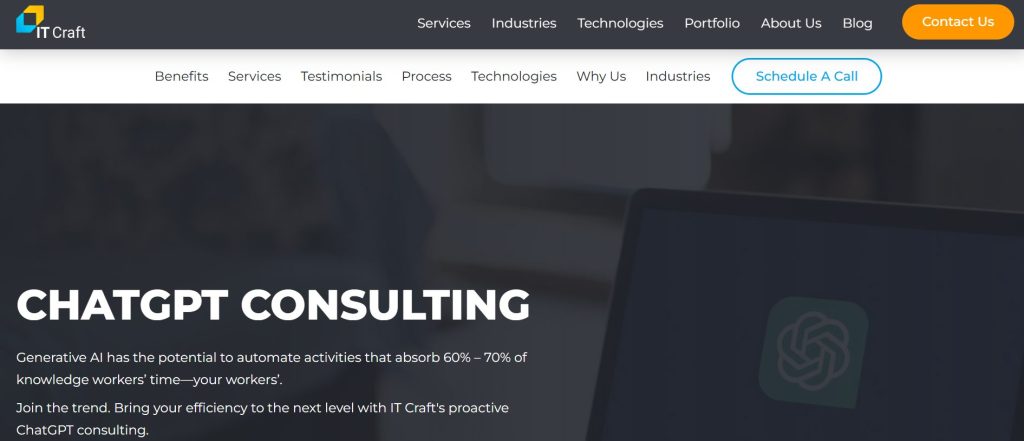
IT Craft specializes in custom AI solutions, ChatGPT consulting, OpenAI integrations, chatbot development, SaaS products, and full-cycle software engineering. The company is a good fit for businesses that need not only advice, but also a team that can build, integrate, test, launch, and support the product after release.
A recent case in IT Craft’s portfolio is BibleLytics, a cross-platform wellness app where the team integrated ChatGPT to interpret users’ emotional states and match them with personalized Bible verses. IT Craft handled the full development cycle, delivering a practical AI integration that solves a complex, context-sensitive challenge within a startup budget.
Best for: Custom ChatGPT solutions and AI product development
Biggest Strengths: OpenAI integrations, AI consulting, custom chatbot development, SaaS and software engineering expertise.
3. Capgemini

Capgemini operates globally and serves enterprise clients in technology, finance, manufacturing, retail, public services, and other industries. Its Data and AI services focus on generative AI strategy, cloud and data foundations, AI agents , infrastructure readiness, responsible AI, and large-scale implementation.
Best for: Enterprise implementation
Biggest strengths: Cloud, infrastructure, and large-scale AI deployments.
4. Eliza
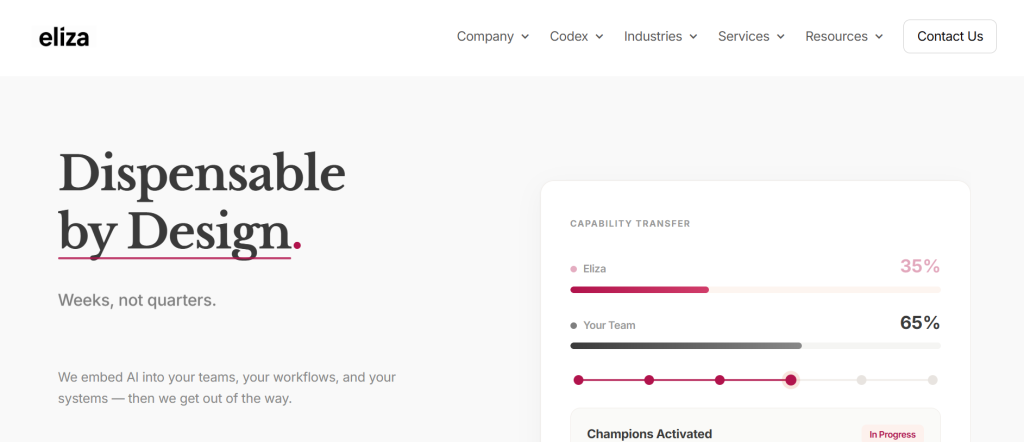

Eliza is an AI-native consulting and implementation firm that works with companies adopting ChatGPT and frontier AI inside real workflows. Its services include ChatGPT Enterprise enablement, workflow automation, AI workforce training, custom agents, production AI systems, and enterprise integrations.
Best for: Mid-market to enterprise AI rollouts
Biggest strengths: ChatGPT enablement, workflow automation, AI workforce training, custom agents.
5. Intelliarts

Intelliarts operates from Eastern Europe and serves companies that need software engineering, data products, machine learning, and AI-powered systems. Its ChatGPT and AI services focus on AI chatbot development, domain-specific knowledge assistants, LLM solutions, RAG systems, NLP pipelines, enterprise integrations, and production AI applications.
Best for: Custom ChatGPT applications
Biggest strengths: AI chatbot development, enterprise integrations, production AI systems.
6. Paul Okhrem AI Consulting

Paul Okhrem AI Consulting works with CEOs, boards, and executive teams on AI strategy, transformation, and implementation. The practice helps companies identify high-value AI use cases, redesign workflows, evaluate vendors and architectures, establish governance, and oversee implementation, including generative AI and AI agent initiatives.
Best for: Executive AI strategy and transformation
Biggest strengths: AI strategy, AI decision-making, governance, implementation oversight, AI agents.
AI Agentic Platform For Building Portable AI Agents
Say Hello To Agentic AI That Connects With Your CRM And Even Other Agents